*data sources listed at end
Trees cover a majority of the Earth's Surface area and are home to millions of species. Despite feeling insignificant alone, each tree plays a vital role in the environment!
Today there are over 73,000 estimated species of trees that exist in the world! Animals are often the primary inhabitant of trees, and similarly, humans make use of trees in their own way, such as for food production, agriculture, or logging.
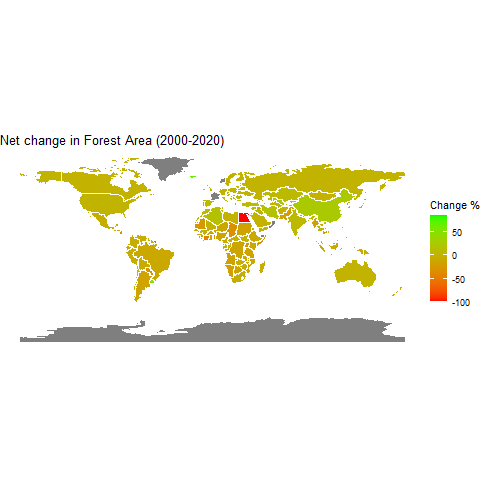
Trees are a major contributing factor to a healthy ecosystem. This article will visualize how deforestation has changed around the world, and the outcomes as a result of. There are many everyday activities that are impacted by the presence of these natural components, such as the conversion of carbon dioxide into oxygen! More on that topic below.
There are many factors that lead to loss of forest cover. According to the Global Forest Watch in 2024, commonly reported drivers included logging, hard commodities, permanent agriculture, settlements and infrastructure, shifting cultivation, wildfires, and other natural disturbances.
The single most potent contributor to deforestation in 2024 was wilfires, a natural disaster responsible for almost 14 million hectares of forest damage.
Agriculture on the other hand, is responsible for almost 7 million hectares of deforestation globally.
Lastly, logging contributed another 5.25 million hectares in damages.
Increased carbon dioxide emissions has been a primary point of concern when it comes to deforestation. One of the previously mentioned factors which contributed significantly to deforestation was farming and agriculture. Pendra et al. (2019), measured the carbon dioxide (Co2) emissions per capita of several countries. According to the data in the year 2013, countries that led in emissions from agriculture and pastures which required deforestation was Luxembourg and Brazil, totaling over 12% of the share of total emissions each, or over 2.7 per capita embodied emissions.
What exactly is "per capita embodied emissions"? To understand the context of the plot, it is important to understand this represents the total amount in tons, per person in the country, that was generated from importing food or other natural resources. This production of material is a prime driver of deforestation, with key products including beef, soybean, and palm oil.
What about other living inhabitants aside from trees? How does the biodiversity get affected by deforestation? According to the Global Living Planet index, which measures the diversity and abundance of living beings in a given region, there have been significant changes in animal populations since its initial conception, strongly linked with habitat loss related to deforestation.
Between the year 1970 and 2020, the majority of continents has seen a decrease, with some anomalies such as the year 1990, which featured a major spike in Europe and Central Asia. However overall, there was a noticeable decrease in recorded LPI across all the regions. This could likely indicate some correlation between loss of forest area and habitability of an ecosystem.

Despite that however, many countries are making an effort to combat deforestation in an attempt to recover lost plant life. For example, in June 2019 to March 2020, the "Black Summer" bushfire swept the South-east coast of Australia through New South Wales to Queensland; areas of which contained a significant amount of forest area, amounting to over 510,000 hectares, but...
...the following year, a multitude of organizations reached out to lend support for reforestation from the bush fires, with groups such as the Parks and Wildlife Services, university researchers, and other non profit organizations all contributing to the analysis for treatment of several affected areas, such as Adelaide, New South Wales (Southeast), and up towards Gold Coast.
All over the world, forest restoration efforts are being made in order to counteract the constant pressure that forests currently face, from major areas such as in Brazil, Kenya, India, and China; to name a few. The aim of this scrollytelling project is to bring light onto the topic and inspire further advocation for reforestation; an often overlooked problem.
Sources
Part 1: Introduction
|
Part 2: drivers
|
Part 3: Agriculture CO2 emissions
Pendrill, F., Persson, U. M., Godar, J., Kastner, T., Moran, D., Schmidt, S., & Wood, R. (2019). Agricultural and forestry trade drives large share of tropical deforestation emissions. Global Environmental Change, 56, 1-10.– processed by Our World in Data |
Part 4: Living Planet Index
World Wildlife Fund and Zoological Society of London (2024) – processed by Our World in Data |
Part 5: Forest Fires
Above source used in both 'primary drivers', and 'wildfire loss' |
Part 6: Australian Bushfires and Conclusion
|